

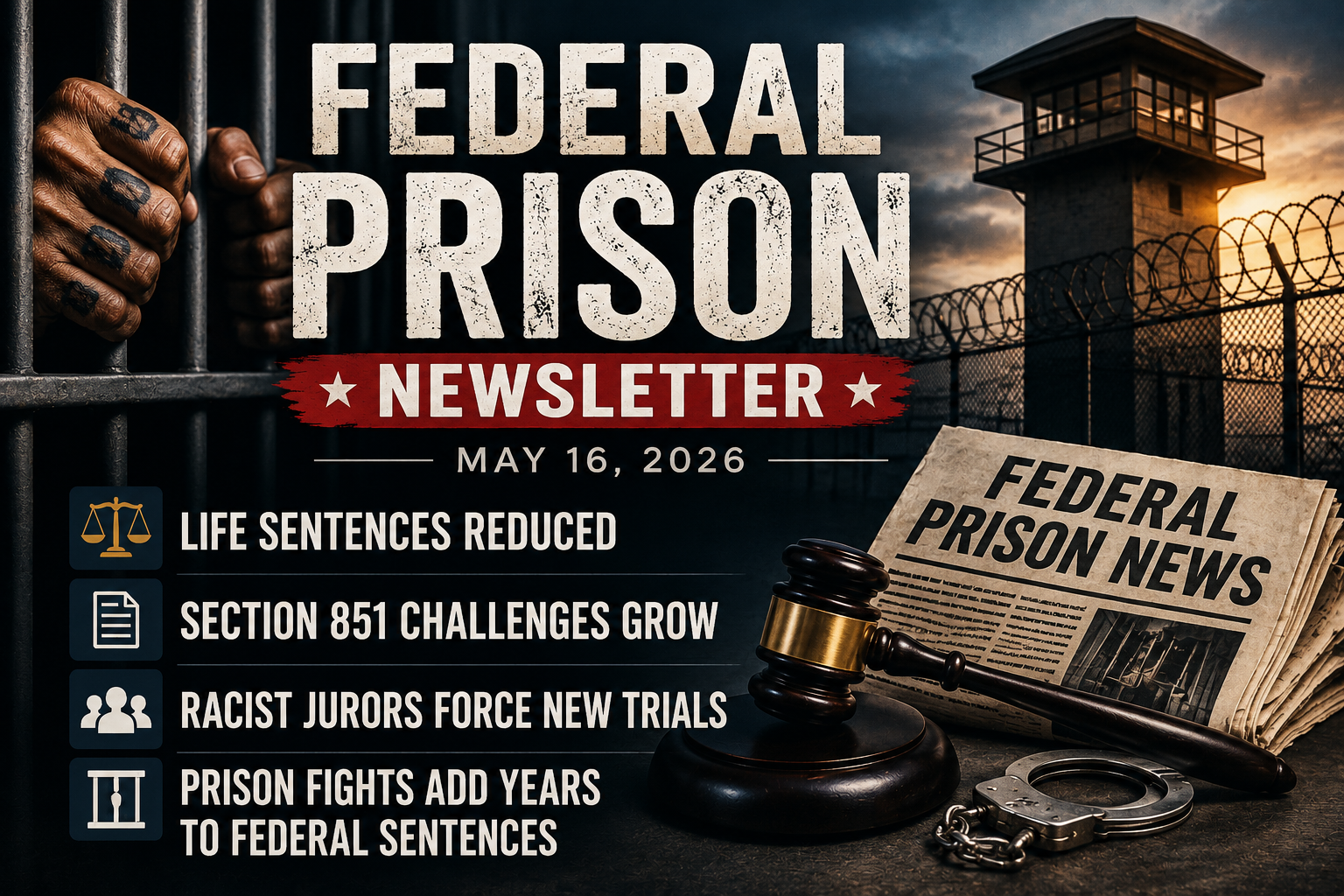
Every week, we review important new federal court decisions involving sentencing, appeals, compassionate release, supervised release, habeas corpus litigation, and other postconviction issues affecting people in prison. The goal of this newsletter is not just to summarize cases, but to explain why these rulings matter, how they may apply to other federal prisoners, and what legal issues people should understand when seeking postconviction relief. Each case includes links to download the actual court decision along with additional analysis breaking down the legal arguments, mistakes made by the courts or attorneys involved, and how these rulings may help others challenging convictions or sentences.
United States v. Bonita, 2026 U.S. Dist. LEXIS 104178 (M.D. Fla. May 12, 2026)
Mandatory Life Sentence Reduced After Court Finds Extreme Sentencing Disparity and Trial Penalty
The district court reduced Eric Bonita’s mandatory life sentence to 240 months after finding that the sentence created a gross disparity compared to both current law and the sentences imposed on his co-defendants. Bonita originally received a mandatory life sentence under 21 U.S.C. sec. 841(b)(1)(A) because of a sec. 851 enhancement based on prior drug convictions, but the court explained that those convictions would not qualify today as “serious drug felonies.” The court also emphasized that multiple co-defendants who played similar or greater roles in the conspiracy received far lower sentences, including several who later received sentence reductions or clemency. The judge noted that he never believed the case warranted a life sentence but imposed it because the law required it at the time, and ultimately concluded that the sentence was far greater than necessary under current sentencing law and created an unwarranted sentencing disparity.
United States v. Dralle, 2026 U.S. App. LEXIS 13619 (2d Cir. May 12, 2026)
Court Vacates Sentence After Judge Improperly Relied on Co-Defendant’s Violent Conduct
The Second Circuit vacated an above-guidelines sentence after holding that the district court improperly relied on violent conduct committed by a co-defendant that had no connection to the defendant’s own offense conduct. Although Dralle pleaded guilty only to receiving a trafficked firearm, the district court increased his sentence after discussing two separate shootings involving the co-defendant who sold him the firearm, even though there was no allegation that Dralle participated in those shootings, knew about them, or was involved in any jointly undertaken criminal activity or conspiracy. The Second Circuit held that sentencing courts cannot increase a defendant’s punishment based on unrelated conduct committed by other people unless the conduct falls within jointly undertaken criminal activity and was reasonably foreseeable to the defendant. Because the district court improperly treated the co-defendant’s violent conduct as “context” for imposing a harsher sentence without any legal basis tying that conduct to Dralle, the sentence was vacated and the case was remanded for resentencing.
United States v. Evans, 2026 U.S. App. LEXIS 13572 (8th Cir. May 12, 2026)
Section 851 Enhancement Procedure May Now Be Unconstitutional When Defendants Challenge Enhancement Facts
The Eighth Circuit affirmed the district court’s refusal to apply a sec. 851 enhanced mandatory minimum after finding that the statute’s procedure for resolving disputed enhancement facts may now violate the Sixth Amendment. Under the enhancement, the government had to prove not only the existence of a prior conviction, but also additional incarceration-related facts, including that Evans served more than 12 months in prison and was released within 15 years of the new offense. After Erlinger v. United States clarified that judges cannot find those types of facts and that they must instead be decided by a jury, Evans challenged the enhancement under sec. 851(c). The problem was that sec. 851(c)(1) expressly requires disputed enhancement facts to be decided by “the court without a jury.”
The Eighth Circuit held that once Evans challenged the enhancement, the district court faced a constitutional catch-22 because applying the enhancement without a jury violated the Sixth Amendment, but using a jury violated the plain language of sec. 851(c)(1). The court therefore affirmed sentencing without the enhanced mandatory minimum. The ruling does not make all sec. 851 enhancements unconstitutional, but it creates a major issue whenever a defendant challenges enhancement facts beyond the mere existence of the prior conviction itself.
United States v. Howard, 2026 U.S. Dist. LEXIS 105750 (D. Kan. May 13, 2026)
Counsel Was Ineffective for Failing to Object to Improper Guideline Enhancement
The district court granted Howard’s sec. 2255 motion after finding that counsel rendered ineffective assistance by failing to object to a clearly inapplicable two-level guideline enhancement that increased Howard’s sentencing range. Howard was convicted only under 18 U.S.C. sec. 922(u), but the PSR still added a two-level stolen-firearm enhancement under U.S.S.G. sec. 2K2.1(b)(4)(A), even though the guideline commentary expressly states that the enhancement does not apply when the only offense is sec. 922(u) and the base offense level is calculated under sec. 2K2.1(a)(7). The government conceded that counsel performed deficiently by failing to object to the enhancement, and the district court agreed. The erroneous enhancement increased Howard’s guideline range from 37-46 months to 46-57 months, and because the court imposed a bottom-of-the-guidelines sentence of 46 months, the district court found a reasonable probability that Howard would have received only 37 months had counsel properly challenged the enhancement.
United States v. Sanchez, 2026 U.S. App. LEXIS 13615 (9th Cir. May 29, 2026)
Racial Bias During Jury Deliberations Required New Trial Despite Removal of Racist Juror
The Ninth Circuit reversed Sanchez’s conviction and ordered a new trial after finding that racial bias during jury deliberations tainted the verdict. During deliberations, one juror reported that another juror made racist comments about Mexicans, including statements that “the Mexicans, all they want to do is screw us over anyway” and comments suggesting cartel involvement because Sanchez worked for a company called Fiesta Pro Services. Although the district court removed the biased juror and questioned the remaining jurors, the Ninth Circuit held that this was not enough because racial bias can affect deliberations in subtle ways jurors themselves may not recognize or admit. The court explained that the problem was not limited to whether other jurors directly heard racist remarks; the biased juror’s views of the evidence and influence over deliberations may also have shaped the verdict. The court criticized the district court for focusing only on whether jurors heard racist comments instead of investigating whether the juror’s racial bias affected how the evidence was discussed and evaluated. It also noted that the remaining jurors were allowed to continue deliberating without being instructed to begin deliberations anew after the racist juror was removed. The Ninth Circuit emphasized that racial bias inside a jury room fundamentally undermines confidence in the verdict itself, with one judge explaining that once racial bias enters deliberations, “the tree itself has been poisoned.”
United States v. Tetzlaff, 2026 U.S. App. LEXIS 13695 (8th Cir. May 13, 2026)
Prison Fight Added Another 10 Years to Defendant’s Existing Federal Sentence
The Eighth Circuit affirmed a 120-month consecutive sentence imposed after Tetzlaff was convicted of assault causing serious bodily injury stemming from a prison fight that unintentionally resulted in another inmate’s death. Tetzlaff reportedly had only about six years remaining on his original federal sentence, but the new conviction added another 10 years consecutive to that sentence, effectively turning roughly six years left in prison into approximately 15 more years in federal custody.
BOP NEWS
I heard from some trusted sources that the BOP is going to be dropping some new program statements any day now. My sources tell me there will be changes for SOs (in a good way) but it’s not very clear yet. It sounds like more people will be getting email, at least. There are also custody level changes coming and more power for the DOJ to intervene in BOP decisions. I’ll have a full report once they become public. So, there you go, all the people who keep asking me if anything new is coming. Apparently, there is. And it is badly needed.
Supreme Court News
Finally, I’m watching some interesting cases in the Supreme Court. These are pending petitions, but the rumor is that they are getting lots of attention.
Whether a litigant can claim relief from judgment under Federal Rule of Civil Procedure 60(b)(6) when a change in settled procedural law retroactively vitiates the litigant’s reasonable reliance on the law.
Whether the Fifth and Sixth Amendments prohibit federal courts from increasing a criminal defendant’s authorized punishment based on conduct—including uncharged, dismissed, or acquitted conduct—that was never admitted by the defendant or proven to the jury beyond a reasonable doubt.
Whether an individual who did not commit the qualifying predicate offenses required to trigger the Armed Career Criminal Act’s 15-year mandatory minimum sentence enhancement in a noncapital case can assert the actual innocence exception to procedural bars on habeas corpus relief.

Dale Chappell works with individuals, families, and attorneys on sensitive and high-profile federal cases, focusing on prison preparation, housing, and post-conviction strategy. He supports clients and legal teams with research, issue analysis, and drafting used in federal post-conviction matters, including § 2255 motions, appeals, sentence reductions, and related filings.
His work is based on nearly 17 years of experience and more than 450 published articles in legal publications focused on post-conviction relief. His focus is helping clients and their families understand how the system actually works and avoiding preventable mistakes.
Have questions?
Email Dale directly at dale@dale-chappell.com.
Leave a Reply